
Going forward, the February factory output may be impacted as several industries such as automobiles, technology, pharma and fashion have some exposure to imports of raw and intermediate materials from China.

The substantially increased economic dualism may exert lasting negative influences which could include a reduced potential for economic growth; the persistence of a very weak employment and poverty situation; rising social and political discord; and heightened vulnerability to geopolitical challenges, cautions Shankar Acharya, former chief economic adviser to the Government of India.

The manufacturing sector during the fourth quarter recorded a growth rate of 9.3 per cent while the farm sector grew at 2.3 per cent.

The report was made public on the eve of the 16th anniversary of the RTI Act after a study of 20 Information Commissions including the Central Information Commission which have put out data on the cases disposed of and penalties levied by them, a statement from the Satark Nagrik Sangathan said.

Minister of state for personnel Jitendra Singh said it is a major step to place the right talent for the right role.

For 2017-18 and 2018-19, investors are better off focusing on the quality of measures announced in the Budget and outside it rather than on the Budget numbers themselves, says T T Ram Mohan.

Lower revenue collection puts upward pressure on government borrowing, ensuring that it deviates from the glided path of debt reduction

The mismatch between PMI and core sector could also be due to the fact that while core sector is calculated year-on-year, PMI is calculated month-on-month.

The new national income numbers produced by the Central Statistics Office (CSO) have elicited two kinds of reaction.

Women's representation in government jobs is less than 15%.
India's likely medium-term potential growth will almost certainly be markedly lower than that experienced in pre-pandemic years, warns Shankar Acharya, former chief economic advisor to the Government of India.
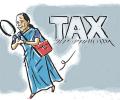
The Central Board of Direct Taxes (CBDT) has extended various tax returns filing deadlines till December 31 this year but it will continue to levy interest on delayed payments made after July 31, the original due date. Officials say tax payment has to be done through net banking, and the assessee doesn't need to use the e-filing portal, which has been facing glitches. So, taxpayers have to bear the interest payment liability of 1 per cent per month on the outstanding tax for those who filed a return after July 31.

This was even as the country's economy grew by 7.3%.

The Covid pandemic has left a question mark on how the central government manages its staff.

'If deaths had been properly reported, it would have helped contain the pandemic.'

The final agriculture GDP numbers for 2016-17 are expected to be revised up, as rabi production is looking really good.

In 2015, the Reserve Bank of India cut interest rates by 125 basis points to 6.75 per cent.
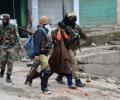
The officer claimed 88 Kashmiri youths joined militancy in 2016.

The Budget decides to take the lead in revving up infrastructure.

The estimates of national income and growth do not pass the 'smell test'.

Congress President Sonia Gandhi has not sought any reimbursement for medical bills from the government, the Central Information Commission has said.

It is too late in the government's term for it to pull its usual trick of blaming the last guys.
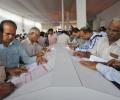
Questions on the efficacy of the government's drive towards filing of more returns by individuals and on whether raising tax exemption levels has led to reduced compliance in filing of returns by those who go out of the tax net, says A K Bhattacharya.

The Rohingyas, who fled to India after violence in the western Rakhine State of Myanmar, have settled in Jammu, Hyderabad, Haryana, Uttar Pradesh, Delhi-NCR and Rajasthan.

It is not a good idea to take the line that since demonetisation happened in the third quarter, everything that happened then was a consequence of that, says Chief Statistician TCA Anant.
The non-oil, non-finance sector of the economy is under severe stress.

India said its economy grew 7.3 percent in the October-December quarter.

He said this in Parliament rebutting reports last month, which quoted the Swiss National Bank, the country's central bank, as saying in its annual report that Indian deposits had risen by 50 per cent in 2017.
.jpg)
Net profit grew 25.4% in Q4 but revenue growth, lower at 8.5%, suggests lack of volume expansion.

Technically, the Indian economy is on road to recovery.

It is pegged at 6.8-8% by various economists, as compared to 6.7%.

From linking innovation with supply of inputs to providing contract farming, the private sector can help agriculture move to the next stage of development.

'The situation is especially serious in major hotspot districts or emerging hotspots like Ahmedabad and Surat (Gujarat), Thane (Maharashtra), Hyderabad (Telangana), and Chennai (Tamil Nadu),' the MHA statement said.

What is required from government is intellectual framework.

Here is all you need to know about the National Population Register and worries over its links with NRC.

Reserve Bank of India Deputy Governor Viral Acharya is the eighth economist to quit since the Modi government took office.

The issue is set to be discussed early next week as the commerce department meets with industry bodies to discuss the widening supply gap for key imports.
The new numbers did not apparently pass consistency checks with production, inputs, or movements in the National Stock Exchange.
Strangely, no consolidated figures on infrastructure investments made on ground are ever disseminated by any official arm of the Government of India.

Murthy, 43, who originally hails from Karnataka, was appointed America's 19th Surgeon General by then president Barack Obama in 2014.
